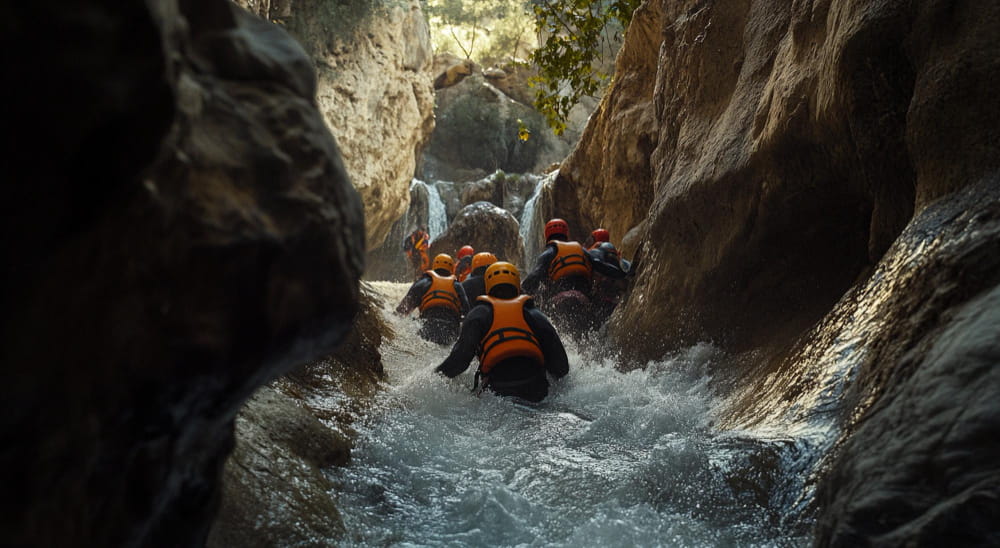
Descending into a gorge is an assault on your equipment. Standard rock-climbing gear is fundamentally designed for dry, clean granite and static, airborne falls. A wet canyon, by contrast, throws freezing water, intense hydraulic forces, highly abrasive limestone and fine grit at every piece of nylon and metal you carry.
What keeps you safe on a sunny sport crag will actively work against you in a waterfall. Standard climbing harnesses act like sponges, basic descenders lack the flexibility needed for varying water flows, and running shoes turn into ice skates on wet, algae-covered rock. Canyoning demands an entirely specialised arsenal of gear built specifically for a constant, high-friction aquatic environment.
The canyoning wetsuit: thermal protection and armour
Water conducts heat away from the body roughly 25 times faster than air. In a canyon, even in the middle of a hot summer, the water trapped in deep, shaded gorges rarely sees sunlight and remains incredibly cold. Therefore, standard swimwear, thin diving shorties or basic surfing wetsuits are entirely insufficient. You need a specialised canyoning wetsuit, typically ranging from 5mm to 10mm in thickness depending on the season and the specific gorge.
These wetsuits are fundamentally different from those used for surfing or diving. Because canyoners spend hours sliding down natural rock toboggans and scrambling over boulders, canyoning wetsuits feature heavily reinforced, abrasion-resistant patches on the knees, elbows and seat. A standard configuration is a two-piece "farmer-john" style with a hooded jacket over the top. This layering system provides double the neoprene thickness over your vital organs, ensuring your core temperature remains stable even when submerged in icy pools for extended periods. Without this thick, protective layer, hypothermia is a rapid and highly dangerous reality.
Footwear: the importance of sticky rubber
If there is one piece of equipment that directly impacts your safety and confidence in a gorge, it is your footwear. The environment is naturally wet, and rocks scoured by water are often coated in a slick mixture of mosses and algae that make them extremely slippery. Standard hiking boots are a severe liability; they trap water, making your feet feel like concrete blocks, and their hard rubber soles slide dangerously on wet limestone. Conversely, old running shoes lack necessary ankle support, fail to grip wet surfaces and will not survive the abrasive environment.
You must wear specialised canyoning boots featuring "sticky rubber" soles. Proprietary compounds like Stealth Rubber offer unparalleled friction on wet rock, allowing you to confidently stem across canyon walls, climb out of slick potholes and downclimb slippery pitches without catastrophic falls. These boots are designed to drain water instantly rather than hold it. Paired with 3mm to 5mm neoprene socks, specialised boots keep your feet warm and padded against sharp rocks while preventing abrasive sand from causing blisters.
The harness: built for abrasion, not hanging
A standard rock-climbing harness is built with thick foam padding to cushion the user during prolonged hanging at a belay station. In a canyon, that padding acts like a sponge, absorbing heavy water and grit. Canyoning harnesses are constructed from heavy-duty, unpadded nylon webbing that sheds water instantly, remains lightweight and resists severe abrasion when scraped against rocks.
Furthermore, a canyoning harness features a higher, more rigid tie-in point. This higher centre of gravity helps keep you upright if you are flipped backwards by heavy water flow in a waterfall. Most distinctively, a canyoning harness is equipped with a thick, replaceable PVC or plastic seat protector. This protective "diaper" shields the structural webbing of your harness, and your expensive wetsuit, from being shredded while you slide down rock faces.
The descender: adjustable friction mid-rappel
Rappelling in a canyon introduces a unique challenge: the weight of the rope and the hydraulic force of the water change drastically as you transition from a dry cliff edge directly into a pounding waterfall. Standard climbing devices, like ATCs or basic figure-eights, offer limited and static friction settings. Canyoneers require specialised adjustable-friction descenders, such as the Petzl Pirana, designed explicitly for these dynamic conditions.
Advanced canyoning descenders feature multiple rope-routing options (including friction spurs and locking grooves) that allow the user to easily increase or decrease braking power without taking the device off the rope. This is critical when you need to slow down mid-descent as the waterfall's volume pushes against you. Another vital safety feature is how these devices connect to the user. The Petzl Pirana utilises a plastic ring that keeps the connector properly positioned, allowing you to thread the rope while the device remains securely attached to your harness carabiner. This eliminates the catastrophic risk of dropping your only descent tool into an inescapable, deep pool with numb fingers.
The ropes and safety essentials
Unlike rock climbing, where dynamic ropes are engineered to stretch and absorb the impact of a falling climber, canyoning strictly utilises static ropes. Static ropes have very little stretch, which limits dangerous bouncing and severe abrasion against sharp cliff edges during a rappel. Canyoning ropes are generally between 8mm and 10mm thick and are chemically treated to repel water, preventing them from becoming impossibly heavy.
Beyond the primary gear, survival in the gorge relies on several safety extras. A hard-shell, well-draining climbing helmet is strictly mandatory to protect against falling rocks and slips on wet ledges. A specialised canyoning backpack with mesh drainage holes is required so water escapes immediately upon exiting a pool. Finally, a readily accessible safety knife is critical; if a rope jams in a strong waterfall current, cutting yourself free may be your only means of survival.
Booking the right experience
Surviving and enjoying a gorge requires respecting the raw power of the environment and utilising the right tools. When booking a guided trip, ensure the operator provides this high standard of specialised gear, rather than cutting corners with cheap running shoes and surfing wetsuits. For those looking to experience world-class descents like the Hrčavka Canyon within Bosnia's pristine Sutjeska National Park, proper equipment is non-negotiable.
For planning your adventure, finding local accommodation and organising fully outfitted, professionally guided canyoning trips, visit visitsutjeskanationalpark.com.