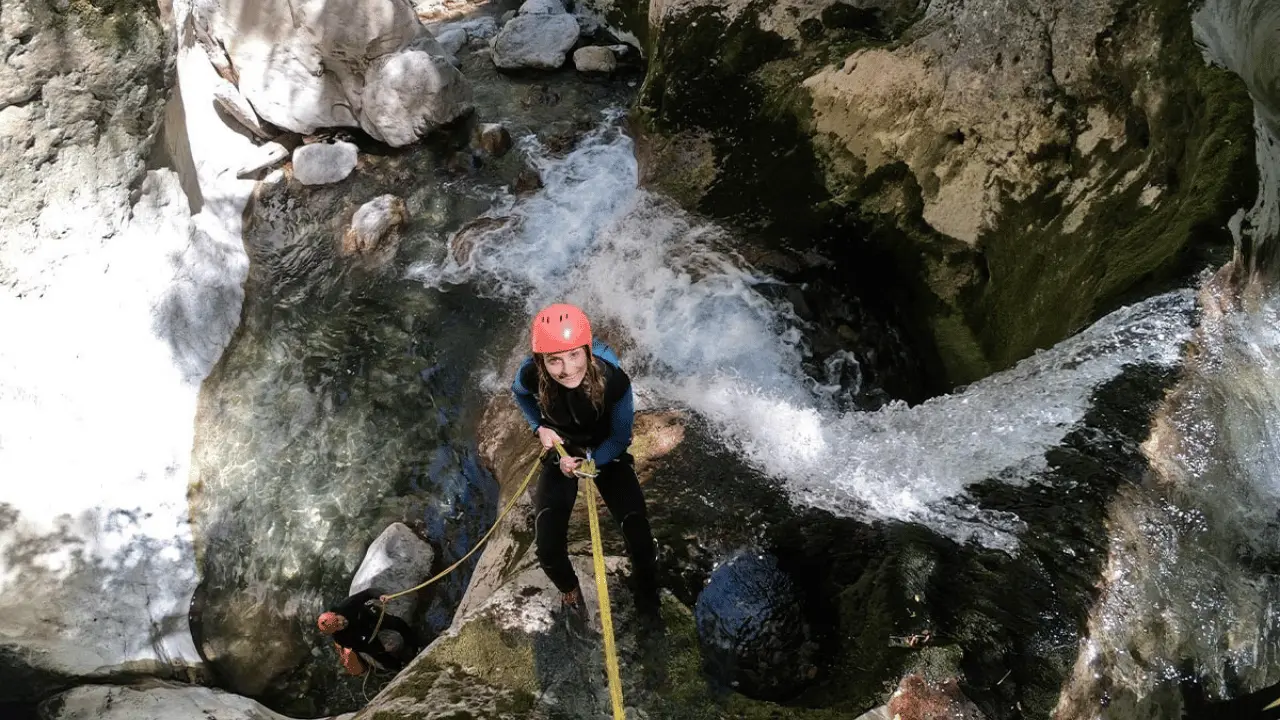
Canyoning in Sutjeska National Park means descending the Hrčavka river gorge on foot and rope, through waterfalls, natural slides, jumps and cold pools, deep inside Bosnia and Herzegovina's oldest national park. If you have searched for canyoning Bosnia and landed here, this is the honest, practical version: what the activity actually is, where it happens, what it costs, and what to expect.
Tours are run by Camp Nomad in Tjentište, led personally by the owner Danilo, a certified canyoning guide at Camp Nomad, with all technical gear provided. Here is everything you need to know before you book.
What is canyoning?
Canyoning (called canyoneering in North America and kanjoning locally) is the sport of travelling down a water-carved gorge using whatever the canyon throws at you. On a single descent you might abseil (rappel) down a waterfall, downclimb over rock steps, jump into deep pools, ride natural rock slides, swim through narrow slots, and scramble or wade between them. It sits between hiking, climbing and swimming, and you do not need to be an expert in any of them.
It is worth being clear how canyoning differs from the activities it gets confused with. Rafting keeps you in a boat on a big river; canyoning puts you in the water and on the rock, moving downstream on your own two feet. Caving goes underground; canyoning stays in daylight in an open gorge. Via ferrata is a mostly dry, fixed climbing route protected by a permanent steel cable and rungs; canyoning is aquatic, multi-directional, and relies on ropes the guide rigs and de-rigs at each drop.
The gear, and why it matters
Cold water and moving rope work drive the kit list. Operators here provide a wetsuit (usually a 5mm full suit for Hrčavka's cold water), neoprene socks, a helmet, a canyoning harness, a descender (belay device) and the ropes, plus a dry bag for the essentials you carry. Grippy canyoning boots matter more than people expect: wet, biofilm-coated limestone is close to frictionless, and lower-leg and ankle injuries from slips are among the most common canyoning injuries.
Camp Nomad provides all of the technical equipment. You bring swimwear, a thermal layer for underneath, a towel and a change of clothes.
Why a certified guide matters
Canyoning is safe when it is run properly and genuinely dangerous when it is not. The best available data, the study "Canyoning Accidents in Austria from 2005 to 2018" (published in the International Journal of Environmental Research and Public Health), found that the absolute risk was 0.02 deaths per 1,000 hours of canyoning, and that death was mainly caused by drowning. In that data, jumping (23.4% of accidents) and rappelling (10.8%) were the leading accident triggers, and flash flooding is behind most multi-person disasters. That is exactly why the person on the other end of the rope is the whole job: assessing anchors, judging water levels, choosing escape routes, and calling off a descent when the forecast turns.
"Certified" should mean something specific. The recognised international benchmark for professional canyoning is ICOpro professional canyoning certification (the International Canyoning Organization for Professionals), founded in 2011 and, by its own account, a model for the international organisation of canyoning practice, with affiliated canyoning centres across 16 countries. Several Sutjeska-area operators, including those running Hrčavka, describe their guides as ICOpro certified. Camp Nomad's tours are led by owner Danilo as a certified canyoning guide, which for a first-timer is the single most important quality signal to look for.
Where it happens: the Hrčavka canyon
The Hrčavka is the largest tributary of the Sutjeska river, and it flows entirely within Sutjeska National Park before joining the Sutjeska near Tjentište. It is a roughly 17-kilometre limestone gorge, so narrow in places that sunlight reaches the water for only a few hours a day. The water stays cold all year, around 4 to 9 degrees Celsius even in August, which is why wetsuits are non-negotiable. The lower canyon ends near the remains of the medieval Tođevac fortress above the valley.
Hrčavka has two canyoning sections. The most-run commercial descent is the lower section, and it is graded as a moderate route (commonly cited as v2 a2 III on the international scale, with Camp Nomad describing its classic line as V3·A4). The classic tour covers roughly 4 km of ground over 3 to 5 hours, with a series of jumps (typically 2 m, 3 m and 5 m), a narrow technical slot, natural slides, swims, and a rope abseil beside a waterfall near the end (operators cite the biggest abseil at around 8 to 10 metres). Fit, experienced groups can link both sections into a longer 6 to 8 hour day.
Commercial canyoning in Hrčavka started in 2014, and it remains the only canyon run commercially inside Sutjeska itself. The Sutjeska river canyon, Perućica (a strictly protected primeval-forest reserve that is off-limits for this kind of activity) and other nearby streams are not run as canyoning routes.
For a wider comparison, Bosnia's best-known canyoning and canyon rivers include the Rakitnica near Konjic (a 26-kilometre canyon between the Bjelašnica and Visočica mountains, described as the second deepest in Europe with cliffs over 800 metres in places, and a tougher, more committing descent), the Vrbas near Banja Luka, and the Neretva tributaries. The famous Nevidio canyon is often marketed alongside Bosnian tours but is actually in Montenegro, in Durmitor National Park on the Komarnica river. We break these down in our Hrčavka vs Rakitnica vs Nevidio comparison.
Getting there
Tjentište sits about a 2.5-hour drive south of Sarajevo and about 1.5 hours from Trebinje. Camp Nomad is the base; from there it is a short transfer (around 30 minutes) to the canyon start, arranged as part of the tour. Roads inside the park include unpaved sections, and a higher-clearance or 4x4 vehicle is useful for some park tracks, though the tour transport is handled for you. For a full breakdown of routes from every direction, see our guide on how to reach Camp Nomad.
Season, fitness and who can do it
The canyoning season runs roughly July through October, with July and August the warmest and busiest, September cooler and quieter, and October the quietest with the best light. Spring snowmelt keeps water levels high and cold early in the year; late summer brings lower, friendlier flows.
No previous experience is needed for the classic Hrčavka route. You should be able to swim, be comfortable in cold water and with heights, and be fit enough to walk several kilometres on uneven ground. Camp Nomad sets a minimum age of 14 with a guardian (16 unaccompanied) and caps groups small, which keeps the guide-to-client ratio safe.
Tours are weather-dependent: Hrčavka can rise fast in heavy rain, so a responsible operator monitors forecasts and reschedules or refunds if conditions are unsafe. If your dates are flexible, that flexibility is worth having.
What it costs, and what the park fee really is
Camp Nomad's guided Hrčavka canyoning tour is priced at 95 EUR per person, and that price includes a bilingual guide, transport, high-quality equipment and the Sutjeska National Park entrance ticket. That is squarely in line with the market: comparable Hrčavka tours run from about 90 EUR up to 130 EUR depending on inclusions like meals.
On the park fee itself, be careful with older figures. As of August 2026, Sutjeska National Park's fees changed sharply after a private lessee took over park facilities. The standard whole-park daily entrance ticket rose to 20 KM (about 10 EUR) per person, doubled from the previous 10 KM (about 5 EUR). A separate, cheaper ticket of 5 KM (about 2.5 EUR) covers only the Tjentište memorial complex zone, not the whole park. Because the canyoning price already bundles in the park ticket, you do not need to buy one separately for the tour. If you plan to explore the park independently, check the official National Park price list for the current figures.
Sutjeska National Park in brief
Established in 1962, Sutjeska is Bosnia and Herzegovina's oldest and largest national park, covering 16,052 hectares. It holds Maglić (2,386 m, the country's highest peak), the Perućica primeval forest (one of the last two remaining in Europe), the glacial lakes of Zelengora, Trnovačko Lake, and the striking Tjentište WWII memorial. That density (a primeval forest, a chain of glacial lakes, the highest summit and a cold canyon in one compact area) makes it an excellent base for a multi-day, multi-activity trip rather than a single stop. For everything beyond the canyon, see the full Sutjeska National Park guide and the Tourist Organisation of Republika Srpska.
Frequently asked questions
Do I need canyoning experience for Hrčavka?
No. The classic Hrčavka route is a moderate grade and suitable for first-timers. Guides teach the rope technique at the start and handle all the technical work.
How cold is the water?
Around 4 to 9 degrees Celsius year-round, even in August. You are given a full wetsuit, neoprene socks, helmet and harness.
What is the minimum age?
14 with a guardian, 16 unaccompanied. You should be able to swim and be comfortable in cold water.
When is the best time to go?
July through October. July and August are warmest and busiest; September and October are quieter and cooler.
What does the tour cost and what is included?
95 EUR per person, including a bilingual guide, transport, all technical equipment and the Sutjeska National Park entrance ticket.
Is canyoning dangerous?
It carries real but manageable risk. Fatal accidents are rare and usually involve drowning or flash floods; going with a certified guide who checks the weather is the single biggest safety factor.