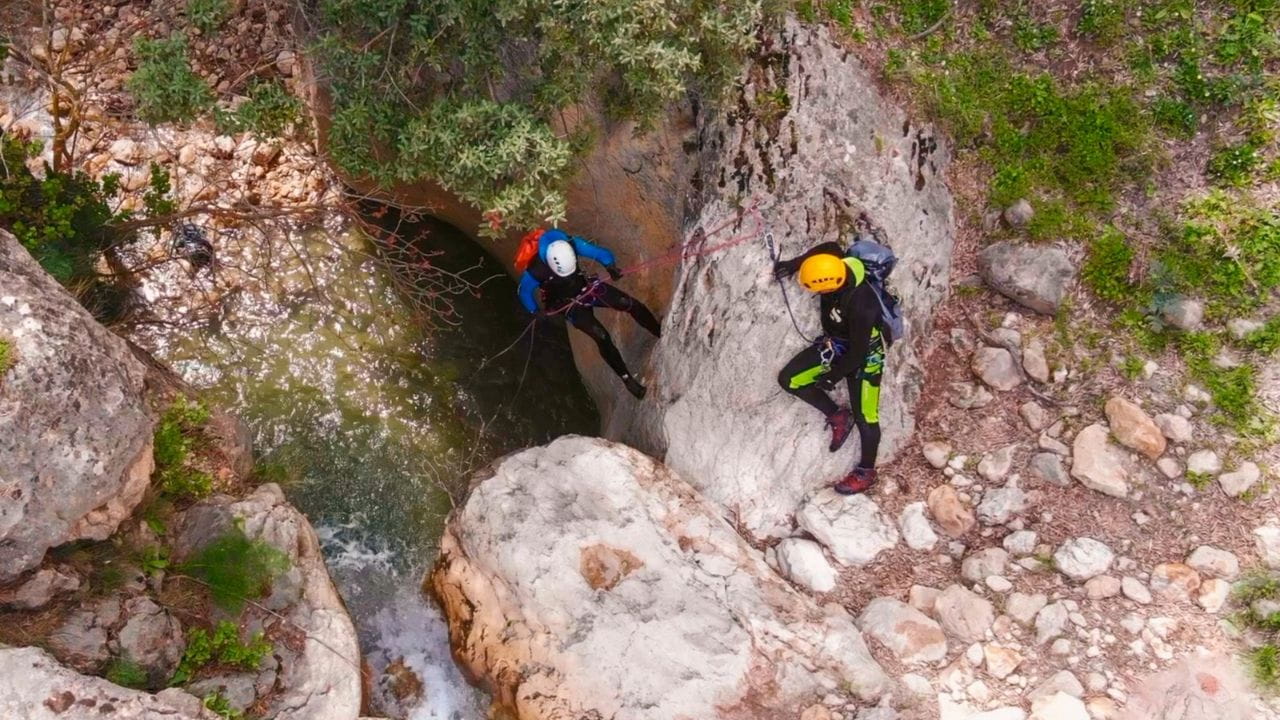
Canyoning takes place in wild, water-carved terrain that you simply cannot access any other way. The fundamental reality of the sport is that once you enter a canyon, you must follow it through to the end, as there is rarely a shortcut out halfway.
Because of this strict physical commitment, understanding the precise difficulty of a route before you step off the edge is a critical component of risk management. To categorise these diverse environments, the international community relies on the grading system established by the French Federation of Mountaineering and Climbing (FFME).
The FFME system uses a three-part alphanumeric code to define a canyon's specific challenges. A standard route description looks like v3 a4 III. This code isolates the three primary factors of a descent: the vertical difficulty (v), the aquatic difficulty (a), and the overall commitment and duration (Roman numeral). Understanding how to read this code allows practitioners to objectively assess the obstacles and choose routes that align with their technical skill and physical fitness.
Vertical difficulty (v)
The first letter, "v" (verticality), rates the technical rope work, climbing and exposure to heights on a scale from 1 to 7. This grade accounts for the complexity of the rappels (abseils), the difficulty of the anchor stations and the physical scrambling required to navigate the dry sections of the gorge.
- Grades v1 to v2: these are introductory routes. They feature simple walking, easy scrambling over uneven terrain, and very short, low-angle rappels that are easily negotiated by beginners.
- Grades v3 to v4: this represents the intermediate threshold. Commercial canyoning guides typically lead beginner to intermediate groups in canyons rated up to v3. At this level, you will encounter mandatory vertical rappels up to 30 metres, requiring proper technique and equipment. Grade v4 introduces more complex vertical challenges, such as multi-pitch rappels, exposed anchor points and tricky overhangs.
- Grades v5 to v7: these are advanced to extreme vertical environments. They require expert-level rope management, complex anchor building and the ability to ascend ropes out of deep potholes. A v7 canyon involves highly precarious, sustained verticality that demands elite technical proficiency.
Aquatic difficulty (a)
The second letter, "a" (aquatic), rates the water-based challenges on a scale from 1 to 7. Because moving water increases exposure to severe hazards like hypothermia and drowning, careful assessment of the aquatic rating is absolutely necessary. This grade evaluates the force of the current, the length of the swimming sections and the presence of dangerous water features.
- Grades a1 to a2: these canyons feature calm, still water. Swimming sections are short, pools are tranquil, and there are no significant water currents to battle.
- Grades a3 to a4: this is where the aquatic environment becomes a significant factor. A route rated a3 involves mandatory swimming, navigating moderate horizontal water movements and managing swift currents. Canyons at the a3 level are generally the upper limit for standard introductory commercial tours. An a4 rating indicates powerful water flow, prolonged immersion, mandatory jumps into aerated water, and the potential need for swift-water float positions and active swimming to escape minor hydraulics.
- Grades a5 to a7: these grades indicate extreme aquatic danger. Participants face powerful, inescapable currents, highly dangerous recirculations (hydraulics) and underwater siphons. Navigating these waters requires specialised swift-water rescue training and extreme physical endurance.
Commitment and duration (Roman numeral)
The final part of the code is a Roman numeral ranging from I to VII, representing the overall commitment, the duration of the descent and the availability of emergency escape routes. The limited access of many canyons can make emergency evacuation difficult and can lead to lengthy waits for external emergency support.
- Grades I to II: these are short canyons, typically taking between 2 to 4 hours to complete. They feature multiple easy escape routes, meaning you can hike out of the gorge relatively quickly if weather deteriorates or an injury occurs.
- Grades III to IV: a grade III canyon usually requires a full half-day to a full day (4 to 8 hours) to descend. Escape routes are scarce and difficult to reach. If an emergency occurs, retreating or evacuating will require significant time and technical effort.
- Grades V to VII: these represent massive, highly committing expeditions. They take anywhere from a full 12-hour day to multiple days to complete. Once you pull your rope on the first rappel, there are absolutely no escape routes. You are entirely committed to finishing the canyon regardless of the circumstances.
Reading the route: decoding "v3 a4 III"
When you look at a canyon topo guide and see the rating v3 a4 III, you can immediately visualise the environment.
The v3 tells you that the vertical drops are moderate. You will need to rappel, but the pitches are likely under 30 metres, and the anchor stations are relatively straightforward to access and manage. The a4 warns you that water is the primary hazard in this specific canyon. You must be prepared for strong, sustained currents, long swims through cold water and powerful waterfalls that require active, aggressive swimming to navigate safely. Finally, the III signifies a solid half-day commitment where emergency exits are rare. You need to carry sufficient thermal protection, emergency supplies and a headlamp, as a minor delay could keep you in the gorge for hours.
The dynamic nature of the gorge
It is vital to understand that canyon grades are assigned based on normal, baseline water levels. Canyons are dynamic environments heavily influenced by rapid weather conditions, geological processes and upstream hydrology. A sudden flash flood triggered by heavy rainfall upstream can instantly turn a manageable a3 canyon into a lethal a6 environment. Sudden increases in water levels pose life-threatening dangers, drastically changing the aquatic difficulty and rendering standard escape routes impassable.
For this reason, commercial canyoning relies heavily on local expertise. Professional guides monitor local catchment areas, utilise up-to-date weather forecasting and understand the exact water-rising rates for their specific routes. Booking a guided descent ensures you are entering the canyon at its optimal, stated grade.
For those looking to experience classic, beautifully balanced v3/a3 terrain, the Hrčavka canyon provides an ideal, guided introduction to the sport. You can book a descent led by certified professionals on our Hrčavka canyoning tour. To explore the wider region, find accommodation and plan further adventures in the surrounding mountains, visit visitsutjeskanationalpark.com.